
Post 5. StreetSignal
Building a coordination layer for homelessness outreach

Why did we build StreetSignal?
Homelessness in Philadelphia is not new, and it’s not hidden. There are long-standing outreach systems, city programs, and community organizations working on it every day. At the same time, there are still clear gaps — especially in how quickly people can be connected to support in real time.
A lot of those gaps show up in ordinary situations. Someone may be in need of outreach, but there isn’t always a clear or immediate way for that moment to translate into a response. Existing systems aren’t always accessible in the moment, and most people aren’t directly connected to them. As a result, many situations that could benefit from outreach don’t lead to anything at all.
In an attempt to close this gap, my friend Will and I built StreetSignal. The idea is straightforward: create a simple way for someone to flag that outreach may be needed in a specific location, and route that information to people who are already trained to respond.
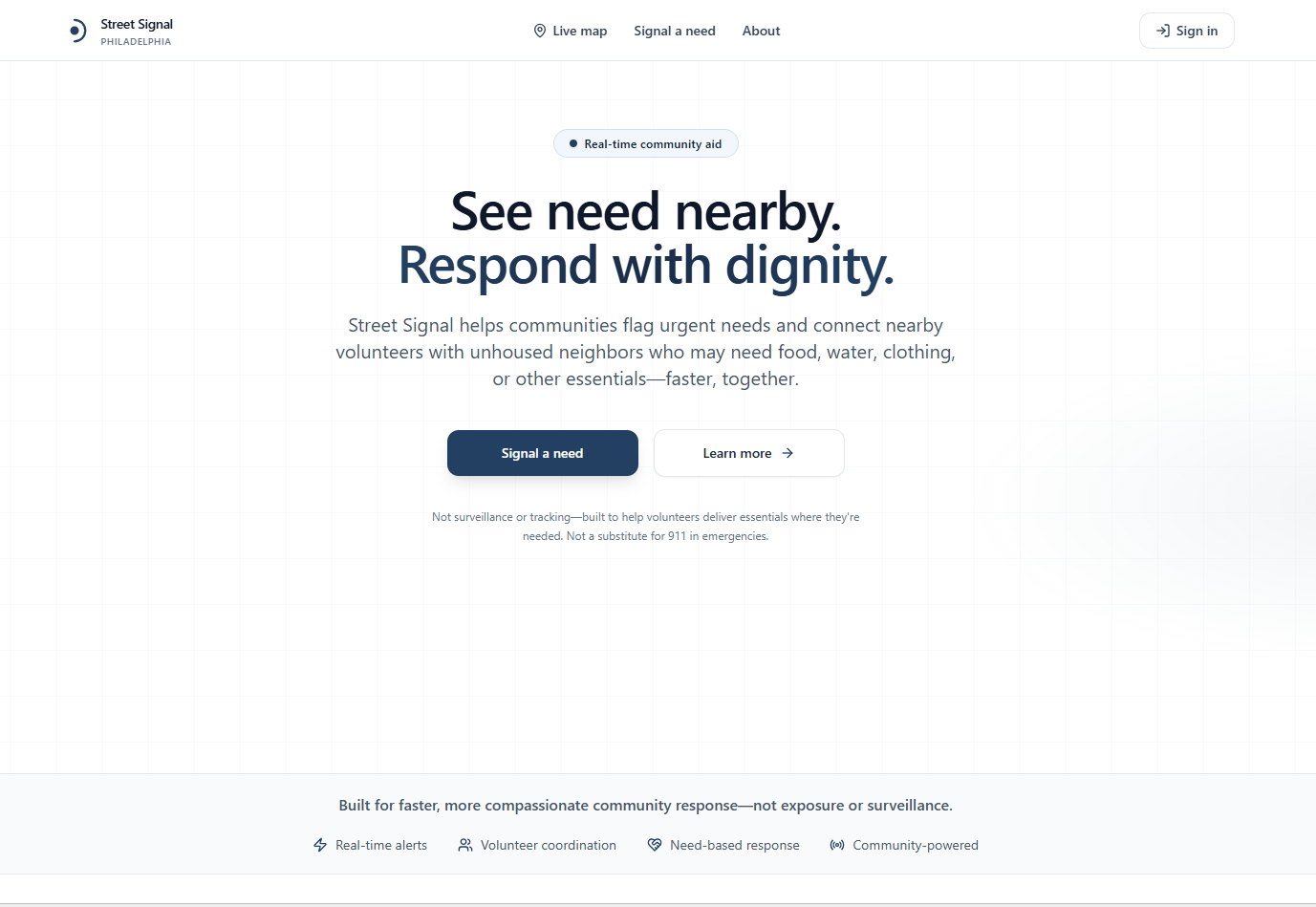
At its core, StreetSignal is a lightweight coordination layer between three groups that are often disconnected in practice: people who notice when outreach might be needed, the organizations responsible for responding, and the systems cities use to understand where gaps exist.
When someone submits a signal, it doesn’t go to the public. It’s routed to a restricted network of verified outreach teams and volunteer partners who already operate in the city. In that sense, it functions less as a standalone product and more as a shared interface into existing infrastructure.
Over time, these signals can also provide an aggregated view of where outreach is being requested — not to track individuals, but to help organizations and city partners understand where demand may be clustering, and where responses are or aren’t happening.
StreetSignal is less about collecting data and more about improving how information moves between people who notice and people who can respond.
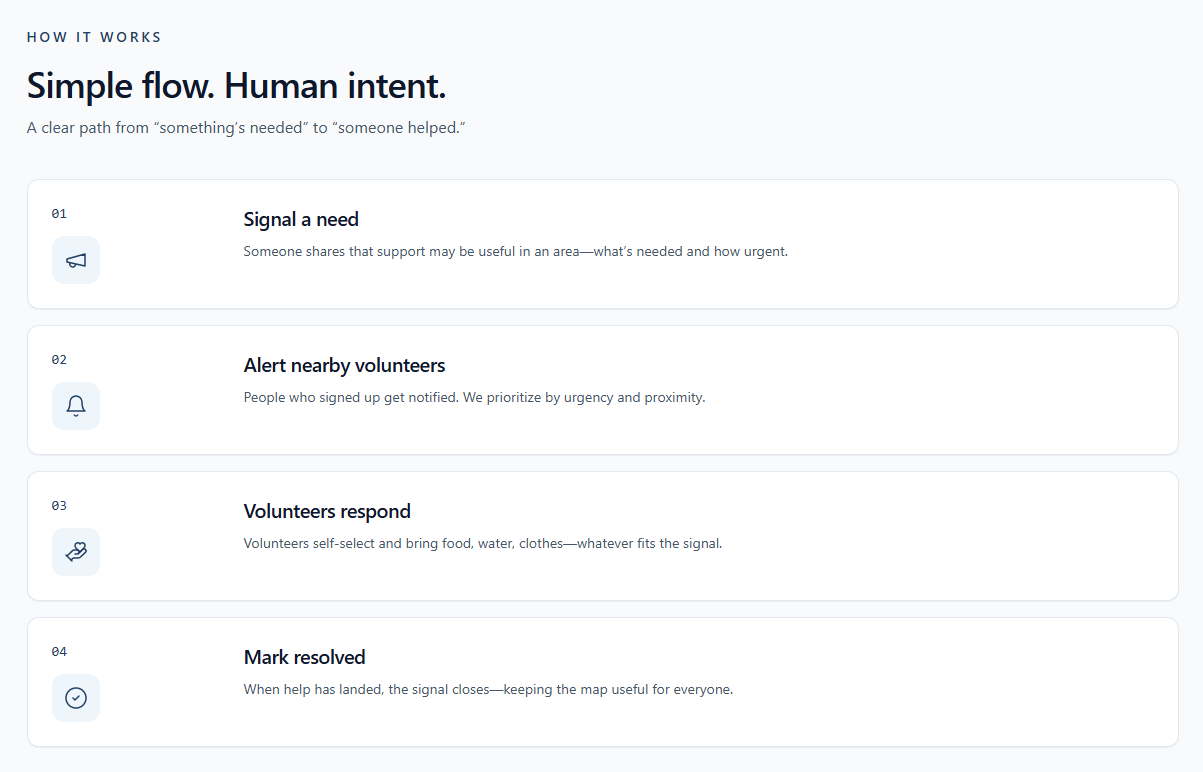
The Approach & Design
The interaction is intentionally minimal.
A user opens the site, selects a location, chooses a general category of support that may be relevant (such as food, shelter, or outreach), and submits.
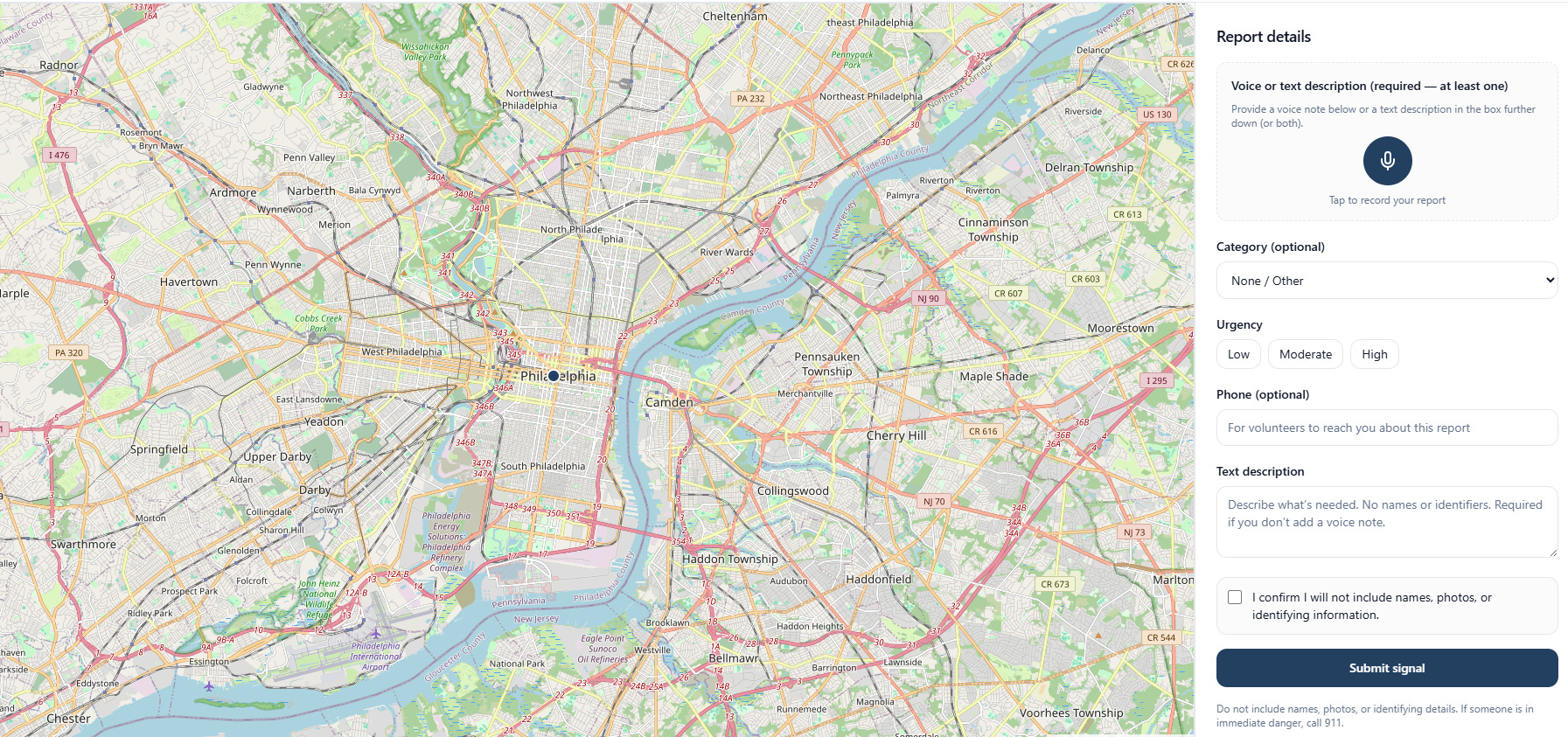
There is no account required, and no identifying information is collected. The system is designed to capture only what is necessary to enable a potential connection.
Nothing in the system identifies or tracks individuals. There are no names, no images, and no persistent profiles. Reports are temporary and limited in scope.
Information is not made public. Signals are only visible to verified responders, avoiding the risk of turning the platform into a space where people are observed or displayed.
Submitting a signal does not trigger any automatic action. It simply creates awareness within an existing network of outreach and volunteer responders. Any interaction that follows remains a standard, in-person engagement, where the individual has full agency to accept or decline assistance
The Signal Response
Once a signal is submitted, it enters a shared queue.
Volunteers can view incoming signals in a dashboard that allows them to filter by location, category, and time. This makes it easier to understand what’s coming in and what may need attention.
Signals can be acknowledged, marked as reviewed, or resolved if someone has followed up. This helps prevent duplication and keeps the system current.
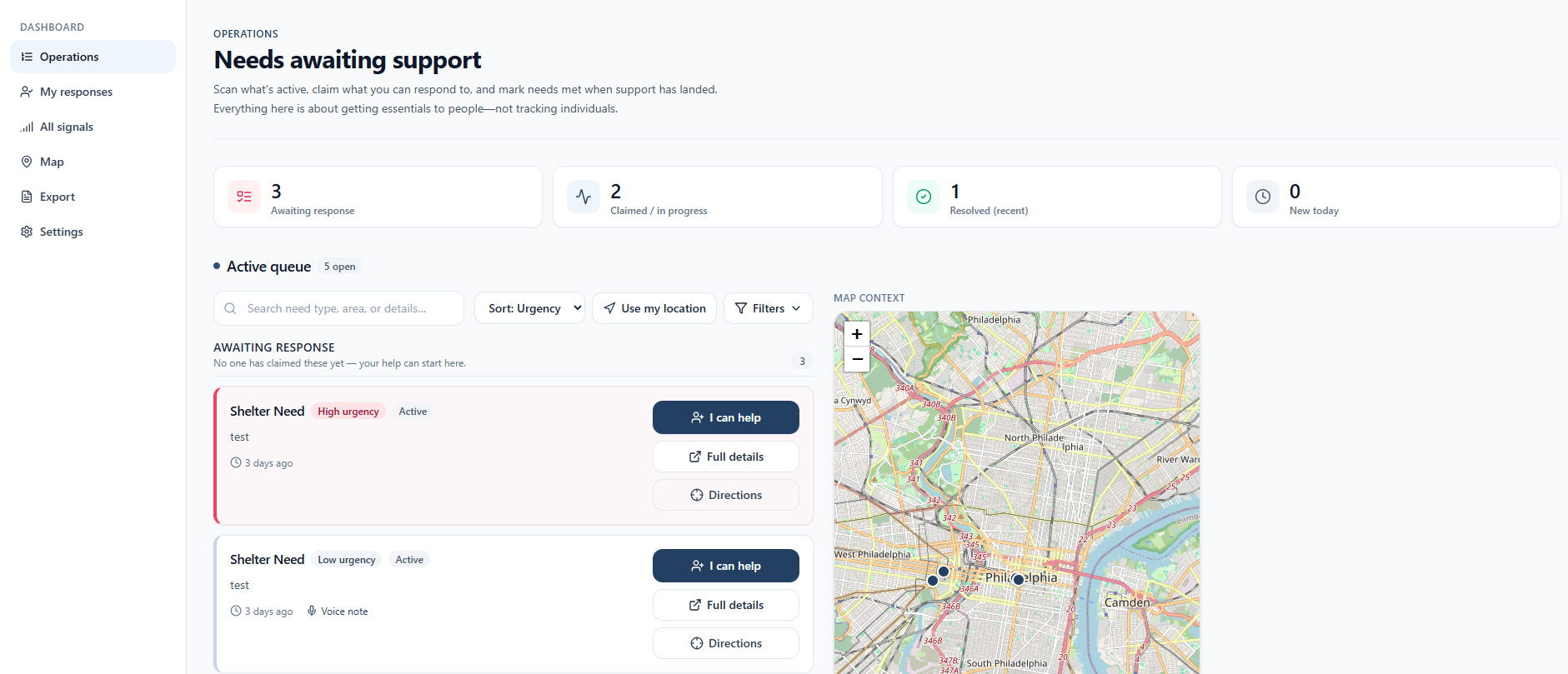
Once a volunteer indicates they can assist, the signal moves to their active responses, allowing them to track follow-up without removing visibility from others in the network.

From there, any engagement happens off-platform.
What’s next for StreetSignal?
StreetSignal is still early.
While the core workflow is in place, there are open questions that need to be worked through before it can be used more broadly.
Some are practical: how to handle time-sensitive situations, how to distinguish more clearly between different types of requests, and how signals should be prioritized.
Others are about fit: how this integrates with existing outreach workflows, and what it would look like for organizations to use it in practice.
The next step is to work through these questions directly with the people already doing this work.
In the coming weeks, we plan to connect with local organizations, outreach teams, and community groups in Philadelphia to gather input and understand whether this is something that would be useful.
If that process is productive, the intention is to bring a more developed version forward as part of the city’s ongoing conversations around homelessness and explore what a small, well-scoped pilot could look like with the City of Philadelphia under Mayor Parker.
If that sounds of interest to you, I hope you’ll consider subscribing and following our journey. Regardless, thank you for taking the time to learn more about StreetSignal!
If this is of interest, I hope you’ll consider following along.
If you have thoughts, ideas, or criticisms, especially if you work in housing or related areas, I’d appreciate hearing them. If you’re connected to organizations or individuals in Philadelphia who might want to engage with this early (or if you are yourself), I’d be glad to connect (jhpatel@wharton.upenn.edu).
Many thanks,
Jack